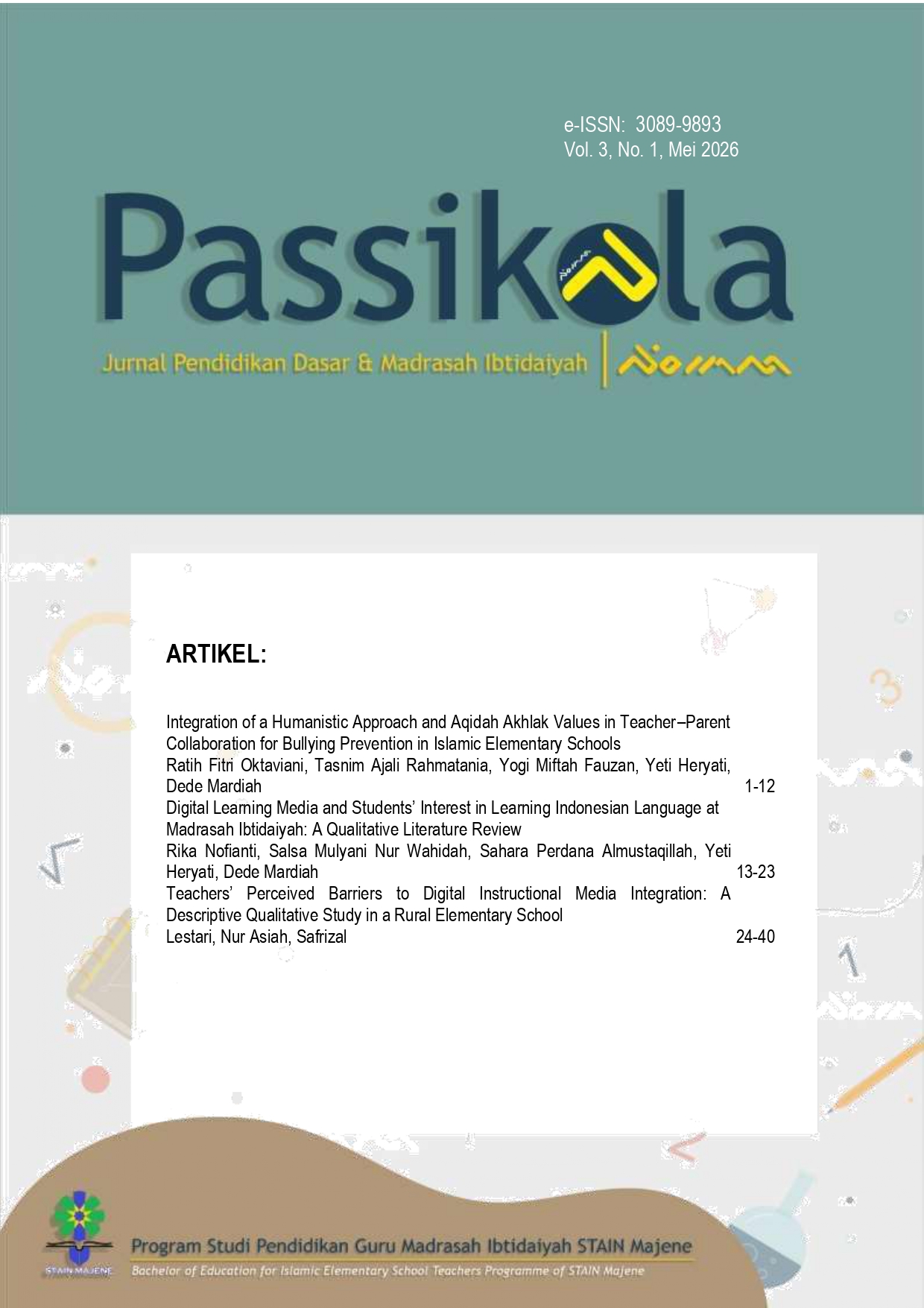
Teachers’ Perceived Barriers to Digital Instructional Media Integration: A Descriptive Qualitative Study in a Rural Elementary School
DOI:
https://doi.org/10.46870/passikola.v3i1.2314Keywords:
Digital Instructional Media , Teacher Perceptions, TPACK, Technological Skills, Perceived Time Cost, Rural Elementary SchoolAbstract
This study aimed to explore teachers’ perceptions of the limited use of digital instructional media at SD Negeri Sungayang and to identify the factors shaping these practices. A descriptive qualitative approach was employed, involving four purposively selected teachers. Data were collected through semi-structured in-depth interviews and analyzed through repeated reading, coding, category development, and theme construction based on the interactive analytical model of Miles, Huberman, and Saldaña. The analysis generated three interrelated themes: limited digital technology operational skills, difficulties in developing and adapting instructional media, and perceived time demands associated with preparing and using media. The findings suggest that limited technological fluency may increase difficulties in media development and perceived time cost, which, for some teachers, contributed to a preference for more familiar teaching methods requiring minimal preparation. These findings can be interpreted through the TPACK framework, particularly as constraints related to Technological Knowledge and Technological Pedagogical Knowledge, rather than as a comprehensive diagnosis of teachers’ TPACK competence. Practically, the findings suggest the potential value of peer mentoring and ready-to-use digital instructional resources, although these strategies require further implementation and evaluation. Given that the study involved only four teachers from a single school, the findings are intended to provide contextual insight rather than broad generalization.
References
Anastasha, D. A., & Hesti, N. (2024). Pengembangan media pembelajaran menggunakan Augmented Reality Assemblr Edu pada materi ekosistem siswa kelas V SD. EDUCATOR: Directory of Elementary Education Journal, 5, 4–6. https://doi.org/10.58176/edu.v5i2.2036
Badaruddin, S. (2024). Cara menangani siswa SD/MI yang memiliki kemampuan pengetahuan yang bervariasi. Passikola: Jurnal Pendidikan Dasar & Madrasah Ibtidaiyah, 1(1), 1-15. https://doi.org/10.46870/passikola.v1i1.1197
Badaruddin, S., Sailan, M., & Suyitno, I. (2021). Effort in Overcoming the Gap Elementary School Teacher Arrangement and Equality. Jurnal Ad’ministrare, 8(1), 233-244.
Berger, R. (2015). Now I see it, now I don’t: Researcher’s position and reflexivity in qualitative research. Qualitative Research, 15(2), 219–234. https://doi.org/10.1177/1468794112468475
Ertmer, P. A., Ottenbreit-Leftwich, A. T., Sadik, O., Sendurur, E., & Sendurur, P. (2012). Teacher beliefs and technology integration practices: A critical relationship. Computers & Education, 59(2), 423–435. https://doi.org/10.1016/j.compedu.2012.02.001
Falah, A. N., Syafitri, A., Syahrani, A. Z., & Safrizal. (2023). Analisis kesulitan calon guru MI dan SD di Kabupaten Tanah Datar dalam pengembangan media pembelajaran berbasis digital. IBTIDA’: Media Komunikasi Hasil Penelitian Pendidikan Guru Madrasah Ibtidaiyah, 4(1), 51–60. https://doi.org/10.37850/ibtida’.
Hasanah, U., Astra, I. M., & Sumantri, M. S. (2023). Exploring the need for using science learning multimedia to improve critical thinking elementary school students: Teacher perception. International Journal of Instruction, 16(1), 417–440. https://doi.org/10.29333/iji.2023.16123a
Husna, M. (2024). Strategi pembelajaran berbasis digital dalam meningkatkan kualitas pembelajaran. AL-FAIZI: Jurnal Hukum, Politik dan Bisnis, 2(2), 166–178. https://www.jurnal.zarilgapari.org/index.php/faizi
Indahyanti, R., & Rahman, A. W. (2022). Teachers’ perception on the use of teaching media in English classroom. Klasikal: Journal of Education, Language Teaching and Science, 4(2), 187–196. https://doi.org/10.52208/klasikal.v4i2.217
Khinanti, L. D., Angelica, Noviana, K., Anggraini, E. S., Simaremare, A., Rambe, F. A., & Manurung, A. (2025). Dampak keterbatasan media pembelajaran terhadap hasil belajar anak usia 5 & 6 tahun di TK Kartini. Jurnal Pendidikan Tambusai, 9(2), 18784–18789. https://doi.org/10.31004/jptam.v9i2.29071
Kournikova, F. A. C., Putri, R. A., Ajmi, F. N., & Saputri, R. E. (2025). Persepsi guru sekolah dasar terhadap teknologi informasi dan komunikasi dalam meningkatkan efektivitas pembelajaran. Didaktik: Jurnal Ilmiah PGSD FKIP Universitas Mandiri, 11, 259–273. https://doi.org/10.36989/didaktik.v11i03.7767
Lincoln, Y. S., & Guba, E. G. (1985). Naturalistic inquiry. SAGE Publications.
Malterud, K., Siersma, V. D., & Guassora, A. D. (2016). Sample size in qualitative interview studies: Guided by information power. Qualitative Health Research, 26(13), 1753–1760. https://doi.org/10.1177/1049732315617444
Merianti, E., & Lasari, Y. L. (2023). Peran media pembelajaran audio visual dalam meningkatkan minat belajar siswa pada mata pelajaran IPS MI/SD. Al-Ihtirafiah: Jurnal Ilmiah Pendidikan Guru Madrasah Ibtidaiyah, 3(1), 26–37. https://doi.org/10.47498/ihtirafiah.v3i01.1560
Miles, M. B., Huberman, A. M., & Saldaña, J. (2014). Qualitative data analysis: A methods sourcebook (3rd ed.). SAGE Publications.
Mishra, P., & Koehler, M. J. (2006). Technological pedagogical content knowledge: A framework for teacher knowledge. Teachers College Record, 108(6), 1017–1054. https://doi.org/10.1111/j.1467-9620.2006.00684.x
Mutmainnah, M., & Khaerunnisa, K. (2024). Analisis persepsi guru terhadap penggunaan media pembelajaran berbasis teknologi dalam proses pembelajaran di kelas. JUPENJI: Jurnal Pendidikan Jompa Indonesia, 3(4), 53–62. https://doi.org/10.57218/jupenji.vol3.iss4.1333
Nisak, R. K., & Rofi’ah, S. (2023). Problematika guru dalam penggunaan media pembelajaran berbasis digital. BASICA: Journal of Arts and Science in Primary Education, 3(1), 41–50. https://doi.org/10.37680/basica.v3i1.3623
Nowell, L. S., Norris, J. M., White, D. E., & Moules, N. J. (2017). Thematic analysis: Striving to meet the trustworthiness criteria. International Journal of Qualitative Methods, 16, 1–13. https://doi.org/10.1177/1609406917733847
Palinkas, L. A., Horwitz, S. M., Green, C. A., Wisdom, J. P., Duan, N., & Hoagwood, K. (2015). Purposeful sampling for qualitative data collection and analysis in mixed method implementation research. Administration and Policy in Mental Health and Mental Health Services Research, 42(5), 533–544. https://doi.org/10.1007/s10488-013-0528-y
Phillips, M., Baran, E., Mishra, P., & Koehler, M. J. (Eds.). (2025). Handbook of technological pedagogical content knowledge (TPACK) for educators (3rd ed.). Routledge. https://doi.org/10.4324/9781032635194
Sandelowski, M. (2000). Whatever happened to qualitative description? Research in Nursing & Health, 23(4), 334–340. https://doi.org/10.1002/1098-240X(200008)23:4%3C334::AID-NUR9%3E3.0.CO;2-G
Tong, A., Sainsbury, P., & Craig, J. (2007). Consolidated criteria for reporting qualitative research (COREQ): A 32-item checklist for interviews and focus groups. International Journal for Quality in Health Care, 19(6), 349–357. https://doi.org/10.1093/intqhc/mzm042
Tracy, S. J. (2010). Qualitative quality: Eight “big-tent” criteria for excellent qualitative research. Qualitative Inquiry, 16(10), 837–851. https://doi.org/10.1177/1077800410383121
Winda, R., & Dafit, F. (2021). Analisis kesulitan guru dalam penggunaan media pembelajaran online di sekolah dasar. Jurnal Pedagogi dan Pembelajaran, 4(2), 211–221. https://doi.org/10.23887/jp2.v4i2.38941
Downloads
Published
How to Cite
Issue
Section
License
Copyright (c) 2026 Passikola: Jurnal Pendidikan Dasar & Madrasah Ibtidaiyah

This work is licensed under a Creative Commons Attribution-NonCommercial-ShareAlike 4.0 International License.