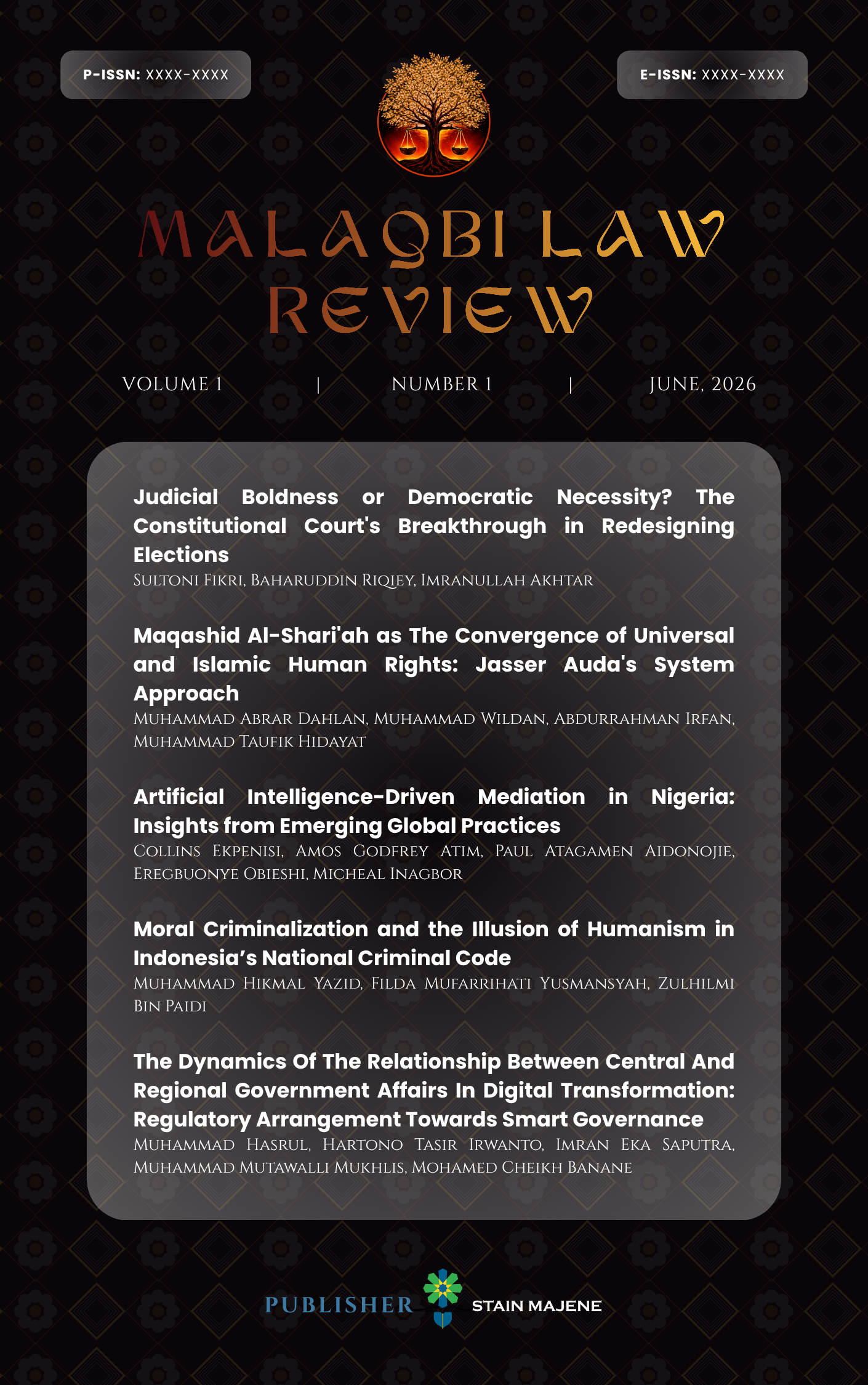
The Dynamics Of The Relationship Between Central And Regional Government Affairs In Digital Transformation: Regulatory Arrangement Towards Smart Governance
Keywords:
State Administrative Law, Regional Autonomy, Smart City, Government Governance, AuthorityAbstract
The transformation of urban governance through the Smart City concept in Indonesia often triggers normative tensions within the framework of central-regional relations. Theoretically, regional autonomy provides local governments with discretion to innovate, but in practice, technology standardization and national data integration are often viewed as a form of digital recentralization of authority. This article aims to analyze the legal standing and division of authority between the Central and Regional Governments in the implementation of Smart City from the perspective of State Administrative Law. Using normative legal research methods and a statutory approach, this study finds a gap in integrative regulations (Electronic-Based Government Systems) that often conflict with regional autonomy in managing household affairs. The results indicate that a reconstruction of the relationship model is needed based on the principle of partnership-consultative, rather than simply hierarchical-command, to ensure the sustainability of accountable and inclusive smart city governance. This transformation demands a redefinition of the central government's oversight function that does not stifle local innovation but rather strengthens the interoperability of public services across levels of government.
References
Adnan, A. A. (2024). Data Quality as a Strategic Lever for MIS Success: Empirical Evidence from Indonesia’s Digital Transformation. Data: Journal of Information Systems and Management, 2(1), 38–50.
Aisyah, S., Hidayah, Z., Juniadi, D., & Purnomo, E. P. (2024). Transforming Smart City Governance for Quality of Life and Sustainable Development in Semarang City, Indonesia. International Journal of Sustainable Development and Planning, 19(9), 3443–3452. https://doi.org/10.18280/ijsdp.190914
Anderson, G. (2010). Fiscal Federalism: A Comparative Introduction. Oxford University Press.
Atmaheni, A. A., & Adianto, J. (2024). Indonesia’s Smart City: Does Legal Framework Matter? International Journal of Built Environment and Scĥientific Research, 8(2). https://doi.org/https://doi.org/10.24853/ijbesr.8.2.93-104
Bardhan, P., & Mookherjee, D. (2006). Decentralization and Local Governance in Developing Countries: A Comparative Perspective. The MIT Press.
BPS. (2025). Telecommunication Statistics in Indonesia 2024. https://www.bps.go.id/en/publication/2025/08/29/beaa2be400eda6ce6c636ef8/telecommunication-statistics-in-indonesia-2024.html
Clement, J., Manjon, M., & Crutzen, N. (2022). Factors for Collaboration Amongst Smart City Stakeholders: A Local Government Perspective. Government Information Quarterly, 39(4). https://doi.org/https://doi.org/10.1016/j.giq.2022.101746
Hanisch, M., Goldsby, C. M., Fabian, N. E., & Oehmichen, J. (2023). Digital governance: A conceptual framework and research agenda. Journal of Business Research, 162. https://doi.org/https://doi.org/10.1016/j.jbusres.2023.113777
Hoesein, Z. A., Arifudin, A., & Rahayu, S. D. (2022). The Effectiveness of Decentralization Policy in Local Government Administration. Jurnal Akta, 9(2). https://doi.org/10.30659/akta.v9i2.23544
Jalaludin. (2024). Indonesia Naik 13 Peringkat UN E-Government Survey 2024, Menpan RB: Transformasi Digital melalui SPBE. KOMPAS.Com. https://kilaskementerian.kompas.com/kementerian-panrb/read/2024/09/20/16201961/indonesia-naik-13-peringkat-un-e-government-survey-2024-menpan-rb
Jati, W. R., Syahid, C. N., Lissandhi, A. N., & Maulana, Y. (2023). Assessing the Implementation of a “City for All” within the New Indonesian Capital City: Smart and Green City Perspective. Journal of Regional and City Planning, 34(3), 232–247. https://doi.org/10.5614/jpwk.2023.34.3.1
Jiang, H., Geertman, S., & Witte, P. (2020). Smart Urban Governance: An Alternative to Technocratic “Smartness.” GeoJournal, 87, 1639–1655. https://doi.org/https://doi.org/10.1007/s10708-020-10326-w
Korompot, M. I. S., Al-Fatih, S., & Pradhan, D. (2021). The Principle of Equality Before the Law in Indonesian Corruption Case: Is It Relevant? Journal of Human Rights, Culture and Legal System, 1(3), 135–146. https://doi.org/https://doi.org/10.53955/jhcls.v1i3.13
Mukhlis, M. M., Hariyanto, Tajuddin, M. S., Paidi, Z. Bin, & Azizah, M. (2025). Legal ambiguities surrounding the role of Regional House of Representatives in Indonesia’s regional autonomy framework. Legality : Jurnal Ilmiah Hukum, 33(2), 334–360. https://doi.org/https://doi.org/10.22219/ljih.v33i2.38409
Mukhlis, M. M., Maskun, Tajuddin, M. S., Andriani, D., Muchtasar, R., & Masum, A. (2025). Regional Government Autonomy in Indonesia: the Ambiguity of the Federalism or Republic Model. Malaysian Journal of Syariah and Law, 13(1), 35–57. https://doi.org/10.33102/mjsl.vol13no1.760
Nastjuk, I., Trang, S. T. N., & Papageorgiou, E. I. (2022). Smart Cities and Smart Governance Models for Future Cities: Current Research and Future Directions. Electronic Markets, 32(1). https://doi.org/10.1007/s12525-022-00609-0
Nguyen, H. T., Marques, P., & Benneworth, P. (2022). Living Labs: Challenging and Changing the Smart City Power Relations? Technological Forecasting and Social Change, 183. https://doi.org/https://doi.org/10.1016/j.techfore.2022.121866
Nugroho, W., Threestayanti, L., Febrian, E., Gintings, C., Widarningsih, A. W., Afandi, Yulianti, R., & Rosdalina, I. (2017). Gerakan Menuju 100 Smart City (1st ed.). Kementerian Komunikasi & Informatika Republik Indonesia.
Pamungkas, B., & Yusuf, M. (2023). Smart-Legislation For Meaningful Participation In Urban Policymaking: An Overview Post-Issuance Of Act Number 13 Of 2022. Journal of Interdisciplinary Law and Legal Issues, 1(1), 25–42.
PanRb. (2024). Indonesia Naik 13 Peringkat pada UN E-Government Survey 2024, Menteri PANRB: Kolaborasi Akselerasi Transformasi Digital Pemerintah melalui SPBE. Kementerian Pendayagunaan Aparatur Negara Dan Reformasi Birokrasi. https://www.menpan.go.id/site/berita-terkini/indonesia-naik-13-peringkat-pada-un-e-governmentsurvey-2024-menteri-panrb-kolaborasi-akselerasi-transformasi-digital-pemerintah-melalui-spbe#:~:text=Menteri Pendayagunaan Aparatur Negara dan,pemerintahan berbasis elektronik (SPBE).
PanRb. (2025). Indeks SPBE Nasional Meningkat, Menteri Rini: Penguatan Integrasi Pelayanan Publik Berbasis Digital. Kementerian Pendayagunaan Aparatur Negara Dan Reformasi Birokrasi. https://menpan.go.id/site/berita-terkini/indeks-spbe-nasional-meningkat-menteri-rini-penguatan-integrasi-pelayanan-publik-berbasis-digital
Prabowo, A., & Tjenreng, M. B. Z. (2025). Decentralization and Regional Autonomy: A Historical and Conceptual Review. International Journal of Science and Society, 7(1), 413–425. https://doi.org/10.54783/ijsoc.v7i1.1082
Prabowo, M. R., Maryani, D., Kawuryan, M. W., & Wargadinata, E. (2026). Digital Governance Transformation in Regional Government: A Multi-Dimensional Framework for Enhancing Public Service Delivery in Central Kalimantan Province, Indonesia. Architecture Image Studies, 7(1), 1208–1222. https://doi.org/10.62754/ais.v7i1.1012
Rachmawati, R., Anjani, D. F., Rohmah, A. ’Ainur, Nurwidiani, T., & Almasari, H. (2022). Electronically-Based Governance System for Public Services: Implementation in the Special Region of Yogyakarta, Indonesia. Human Geographies – Journal of Studies and Research in Human Geography, 16(1). https://doi.org/https://doi.org/10.5719/hgeo.2022.161.5
Rachmawati, R., Rohmah, A. A., Reinhart, H., Ghiffari, R. A., Sensuse, D. I., & Sunindyo, W. D. (2023). Smart City development in “Nusantara”, the new capital of Indonesia: local government and community readiness. Human Geographies, 17(2), 127–148. https://doi.org/10.5719/hgeo.2023.172.2
Tinambunan, H. S. R., Istislam, Hadiyantina, S., Kusumaningrum, A., & Tajudin, A. A. (2025). Recentralization of Mining Licensing Authority and Its Impact on Local Autonomy in Indonesia. Jurnal Suara Hukum, 7(2). https://doi.org/https://doi.org/10.26740/jsh.v7n2.p520-539
Vujanovic, P. (2017). Decentralisation to promote Regional Development in Indonesia (1380).
Wadipalapa, R. P., Katharina, R., Nainggolan, P. P., Aminah, S., Apriani, T., Ma’rifah, D., & Anisah, A. L. (2024). An Ambitious Artificial Intelligence Policy in a Decentralised Governance System: Evidence From Indonesia. Journal of Current Southeast Asian Affairs, 43(1), 65–93. https://doi.org/10.1177/18681034231226393
Widodo, W., Somantri, G. R., & Subroto, A. (2024). Jakarta Smart City Governace: Policy, Actors and Financing. JHSS, 8(3). https://doi.org/10.33751/jhss.v8i3..10653
Winarni, A. T., & Bundianto, D. (2024). Digitalization of Bureaucracy and Good Governance: A Literature Review of Indonesian Public Administration Reforms in the Post–New Order Era. International Journal of Social Welfare and Family Law, 1(2), 55–68. https://doi.org/10.62951/ijsw.v1i2.478
Wiryawan, R. A., Istislam, & Uyun, D. Al. (2024). The Right to Communicate and Accessing Information on the Termination of Access Policy of Unregistered Private Scope Electronic System Operators. Journal of Social Research, 3(2), 620–627. https://doi.org/https://doi.org/10.55324/josr.v3i2.1946
Wujarso, R., Hakim, A. R., Faizah, N., Yasin, V., & Andhitiyara, R. (2025). Digital Transformation in Public Sector Institutions: A Systematic Literature Review and Comparative Country Analysis. Al-Ishlah Jurnal Pendidikan, 17(4). https://doi.org/https://doi.org/10.35445/alishlah.v17i4.8765
Downloads
Published
How to Cite
Issue
Section
License
The copyright of the received article shall be assigned to the journal as the publisher of the journal. The intended copyright includes the right to publish the article in various forms (including reprints). The journal maintains the publishing rights to the published articles. Therefore, the author must submit a statement of the Copyright Transfer Agreement.*)

This work is licensed under a Creative Commons Attribution-ShareAlike 4.0 International License.
In line with the license, authors and third parties (readers, researchers, and others) are allowed to share and adapt the material. In addition, the material must be given appropriate credit, provided with a link to the license, and indicated if changes were made. If authors remix, transform or build upon the material, authors must distribute their contributions under the same license as the original.
________
*) Authors whose articles are accepted for publication will receive confirmation via email and send a Copyright Transfer Agreement.